
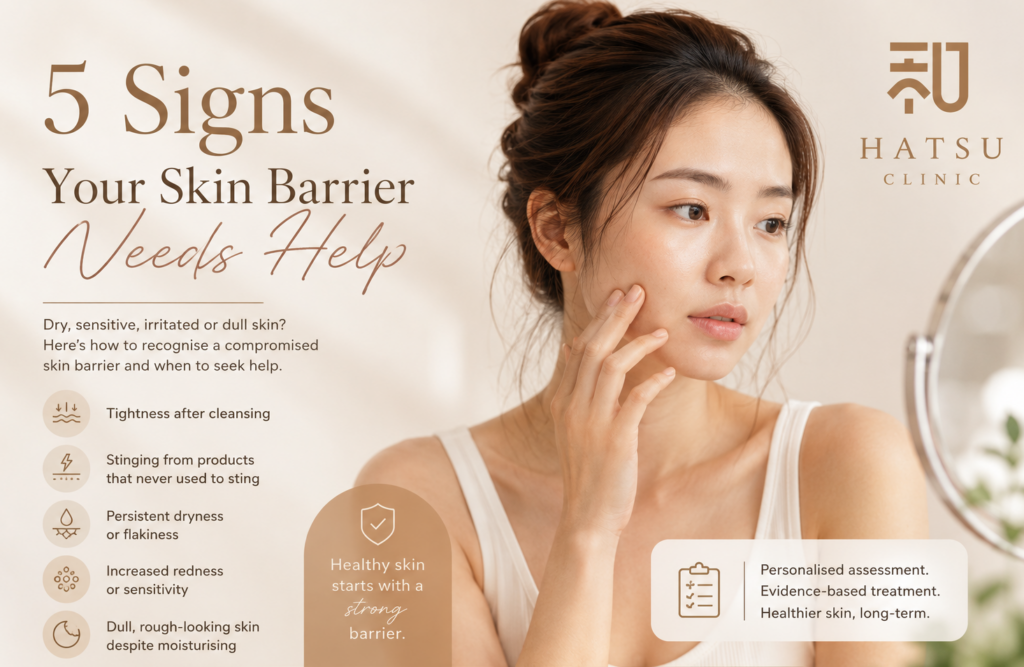
The skin barrier refers to the outermost layer of the skin, particularly the stratum corneum, which works as an important protective interface between your body and the environment.
A healthy skin barrier helps:
Reduce excessive water loss
Maintain skin hydration
Protect against external irritants
Support normal skin function
However, when the skin barrier becomes compromised, they may become unusually dry, sensitive, red, reactive and uncomfortable.
5 Signs Your Skin Barrier May Need Help
1. Skin Feels Tight After Cleansing
While cleansing skin may feel fresh, persistent tightness or discomfort can be abnormal. It may indicate that your cleansing routine may be too harsh for the skin.
Using very strong cleansers, cleansing too frequently or using hot water can usually contribute to dryness and irritation.
A healthy cleansing routine should aim to remove excess oil, makeup and impurities without leaving the skin feeling excessively stripped.
2. Your Skincare Products Suddenly Sting
One of the most noticeable signs of increased skin sensitivity is when products that were previously comfortable suddenly start to sting, burn or feel irritating.
This can happen when the skin becomes more reactive.
It is particularly common when several active ingredients are being used at the same time, for example, exfoliating acids, retinoids and other intensive skincare products.
3. Your Skin Is Persistently Dry, Rough or Flaky
Occasional dryness can happen to anyone due to the change of weather and environment.
However, persistent dryness, rough texture or visible flaking may indicate that your skin is struggling to maintain adequate hydration.
The skin barrier plays an important role in limiting excessive water loss. When its function is disrupted, the skin can become dehydrated and uncomfortable.
When the current moisturiser no longer seems to be enough, consider whether something in your skincare routine may be contributing to the problem.
This is especially important if dryness developed after introducing a new exfoliant, retinoid, acne treatment or intensive skincare routine.
4. Your Skin Has Become More Red or Sensitive
Another common concern is skin that suddenly appears more reactive.
You may notice:
- Increased redness
- Stinging
- Burning sensations
- Increased sensitivity
- Discomfort after cleansing
- Irritation when applying skincare
- Increased sensitivity to environmental changes
However, these symptoms do not mean that the skin barrier is damaged.
Conditions such as eczema, rosacea, contact dermatitis and other inflammatory skin conditions can cause the similar symptoms.
This is why persistent redness or sensitivity should not simply be managed by repeatedly changing skincare products.
A professional assessment can help determine whether you are dealing with barrier disruption or another underlying skin concern.
5. Your Skin Looks Dull Despite Using Plenty of Products
When skin is dehydrated or irritated, its surface may appear rougher and less radiant.
But most of the time, it does not mean that the skin need another serum. Sometimes, a simpler and more appropriate routine can be more beneficial than continuously adding products.
Healthy-looking skin starts with a stable foundation.
Before considering more intensive skin treatments, it is worth to understand whether your skin is adequately hydrated and tolerating your current routine.
What Causes Skin Barrier Damage?
There are many potential contributors to a compromised skin barrier.
Common causes include:
Over-exfoliation
Using exfoliating acids or physical scrubs too frequently can contribute to irritation.
Too many active ingredients
Combining several strong skincare ingredients may overwhelm sensitive or reactive skin.
Harsh cleansing
Strong cleansers or frequent washing can contribute to dryness.
Hot water
Very hot water may worsen dryness and irritation.
Sun exposure
UV exposure can contribute to skin damage and premature ageing.
Environmental pollution
Urban pollution can expose the skin to environmental stressors.
Air-conditioning
Spending long periods in air-conditioned environments may contribute to a dry-feeling complexion.
Underlying skin conditions
Conditions such as eczema and rosacea can also affect skin sensitivity and barrier function.
How to Support Skin Barrier Repair
If your skin is dry, sensitive or irritated, start by returning to the fundamentals.
1. Use a gentle cleanser
Choose a cleanser appropriate for your skin type and avoid excessive cleansing.
2. Moisturise regularly
A suitable moisturiser can help support skin hydration and barrier function.
3. Reduce unnecessary exfoliation
If your skin is already irritated, repeatedly exfoliating may make the problem worse.
4. Introduce active ingredients carefully
Retinoids, exfoliating acids and other active ingredients can be useful for specific skin concerns, but they should be introduced gradually and appropriately.
5. Wear sunscreen
Daily broad-spectrum sun protection is one of the most important parts of maintaining healthy skin.
6. Don’t constantly change your skincare
Switching between multiple products makes it difficult to identify what is helping or irritating your skin.
Frequently Asked Questions (FAQ) About Skin Barrier Repair
Q1: What is the best treatment for skin barrier repair in Malaysia?
There is no single treatment that is best for everyone. The appropriate approach depends on the cause of the barrier disruption, the severity of symptoms, skin type and whether any underlying skin condition is present. For persistent concerns, professional assessment is recommended.
Q2: Where can I get skin barrier treatment in Penang?
If you are looking for professional skin assessment or skin barrier-related treatment in Penang, Hatsu Clinic in Bukit Mertajam provides medical aesthetic consultations and personalised treatment planning based on individual skin concerns.
Q3: How do I repair my skin barrier quickly?
Start with a simple routine: gentle cleansing, regular moisturisation and daily sunscreen. Reduce unnecessary exfoliation and avoid introducing multiple new active ingredients at once. If irritation persists, seek professional advice rather than repeatedly changing products.
Q4: Can a damaged skin barrier cause acne?
A compromised skin barrier does not necessarily cause acne, but irritation and inappropriate skincare may contribute to skin discomfort and can complicate acne management.
Q5: Can I do facial treatments when my skin barrier is damaged?
Some treatments may need to be postponed when the skin is significantly irritated or inflamed. The appropriate timing depends on the condition of the skin and the procedure. An assessment should be performed before any treatment.
Q6: How long does skin barrier repair take?
The recovery period varies according to the cause and severity of the problem. Mild irritation may improve after removing triggers and simplifying skincare, while persistent symptoms may require assessment and treatment for an underlying skin condition.


 English
  Chinese