
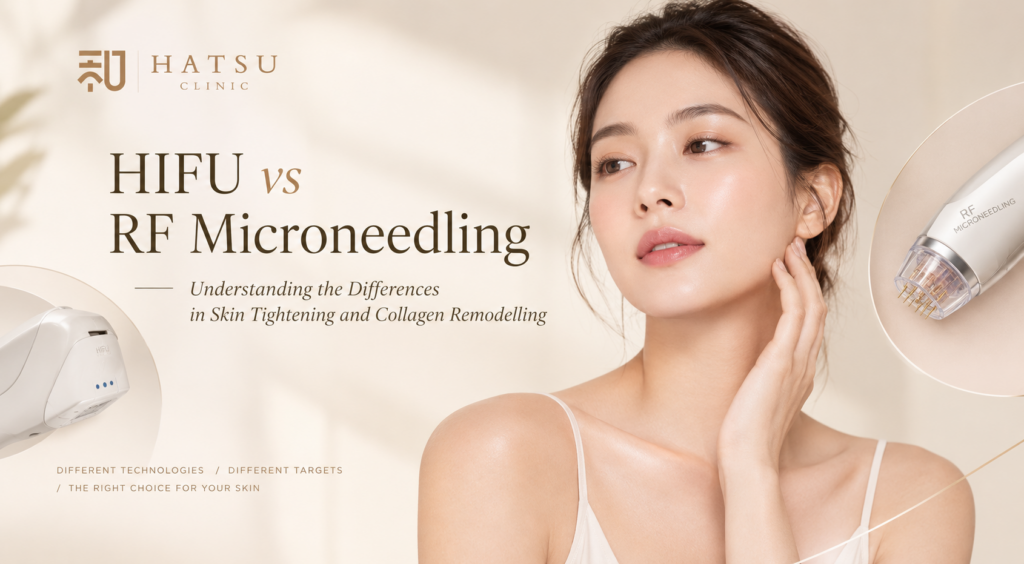
HIFU and RF microneedling are two of the popular non-surgical aesthetic treatments for skin tightening and collagen stimulation. But which one is better for your skin?
If you are considering HIFU or RF microneedling in Penang or Bukit Mertajam, it is important to understand that these treatments do not work in exactly the same way. HIFU uses focused ultrasound energy to target selected deeper tissue planes, while RF microneedling combines microneedling with radiofrequency energy to stimulate collagen within the dermis.
Both can improve skin firmness, but their treatment objectives are different. Hence, by Understanding HIFU vs RF microneedlingcan help you make a more informed decision about which approach may be appropriate for your skin concerns.
HIFU vs RF Microneedling: What are their Difference?
The most important distinction is how and where the energy is delivered.
HIFU
HIFU delivers focused ultrasound energy to selected deeper tissue planes without creating needles or intentional openings in the skin.
Its clinical objective is generally more focused on lifting, tightening and deeper tissue remodelling.
RF Microneedling
RF microneedling uses microneedles to deliver radiofrequency energy into the dermis while also creating controlled micro-injuries.
Its treatment profile is generally more focused on collagen remodelling, skin texture, scarring and firmness.
Therefore, the two treatments should not simply be viewed as competing technologies.
They address overlapping but distinct aesthetic concerns.
HIFU vs RF Microneedling: A Clinical Comparison
| Treatment | HIFU | RF Microneedling |
|---|---|---|
| Energy | Focused ultrasound | Radiofrequency |
| Delivery | Non-invasive focused energy | Microneedles + RF |
| Primary target | Deeper tissue structures | Dermal tissue and skin quality |
| Skin tightening | ✓✓✓ | ✓✓ |
| Facial contour | ✓✓✓ | ✓✓ |
| Acne scars | Limited role | ✓✓✓ |
| Enlarged pores | Limited role | ✓✓✓ |
| Skin texture | Limited role | ✓✓✓ |
| Fine lines | ✓✓✓ | ✓✓✓ |
| Downtime | Generally none to minimal | Usually greater than HIFU |
| Main treatment objective | Lifting and tightening | Collagen remodelling and skin rejuvenation |
Which Treatment Is Better for Skin Tightening?
There is no single treatment that is universally better. The appropriate choice actually depends on your concern.
If your primary concern is facial laxity, early jowling or reduced jawline definition, HIFU may be considered because of its ability to target deeper tissue structures.
Whereas, if your concern include acne scarring, enlarged pores, uneven texture and reduced firmness, RF microneedling may be more appropriate because of the ability to combine controlled dermal injury with radiofrequency heating.
Some patients may have both concerns.
In these cases, different technologies may potentially be incorporated into a sequential or combination treatment plan, depending on the individual’s anatomy, skin condition and treatment goals.
Frequently Asked Questions (FAQ)
Q1. Is HIFU better than RF microneedling?
Neither treatment is universally better. HIFU and RF microneedling use different technologies and target different concerns.
HIFU is generally used for deeper tissue tightening and improvement of facial laxity, while RF microneedling is particularly useful for collagen remodelling, skin texture, acne scars, enlarged pores and mild laxity.
The appropriate treatment depends on your skin condition and treatment objectives.
Q2. Which is better for a sagging jawline ?
If the primary concern is facial laxity, early jowling or loss of jawline definition, HIFU may be more appropriate because it can target deeper tissue planes.
However, the degree and cause of laxity need to be assessed before deciding on treatment. Because not every patient with a less-defined jawline requires HIFU.
Q3. Which treatment is better for acne scars?
RF microneedling is generally more recommended when acne scars, uneven skin texture and enlarged pores are the primary concerns.
PS: Acne scars vary considerably in type and severity, hence treatment selection should be based on the specific scar pattern.
Q4. Can RF microneedling tighten the skin?
Yes. RF microneedling can stimulate collagen remodelling within the dermis and may improve skin firmness and mild laxity.
However, if significant facial laxity is the primary concern, RF microneedling alone is sufficient and you might include another approach for a better outcome.
Q5. Can HIFU improve skin texture and pores?
HIFU is primarily a lifting and tightening treatment rather than a resurfacing treatment.
If enlarged pores, acne scars and uneven skin texture are the main concerns, RF microneedling may be more appropriate.
Q6. Does HIFU hurt?
Treatment sensation varies between individuals and depends on the device, treatment area and energy settings.
Patients may experience warmth, tingling or brief discomfort during energy delivery.
Q7. Does RF microneedling hurt?
RF microneedling can cause some discomfort because it involves both microneedling and radiofrequency energy.
A topical anaesthetic is commonly used to improve comfort before treatment.
The experience varies depending on the treatment area and treatment settings.
Q8. Which treatment has more downtime
HIFU generally has minimal visible downtime because it does not intentionally disrupt the skin surface.
RF microneedling usually involves more visible short-term skin changes, such as redness and swelling, because controlled micro-injuries are created during treatment.
Recovery varies from person to person and depends on treatment intensity and individual healing.
Q9. How many HIFU treatments do I need?
The recommended treatment frequency depends on factors such as your degree of skin laxity, age, facial anatomy, and individual response.
Q10. How many RF microneedling sessions do I need?
The number of sessions depends on the condition being treated.
Patients with concerns such as acne scars or uneven texture may require a series of treatments rather than a single session.
Q11. How soon will I see results?
The results usually develop progressively rather than appearing immediately.
Some changes may be noticed earlier, but collagen-related improvements generally take time.
Y15. Can I have RF microneedling if I have acne?
Active acne should be assessed before treatment.
RF microneedling is generally considered for selected skin concerns such as acne scarring rather than as a treatment that should automatically be performed over active inflammatory acne.
Your doctor will determine whether the timing is appropriate.
Q12. Can HIFU replace a facelift?
No.
HIFU is a non-surgical treatment and should not be presented as equivalent to surgical facelift procedures.
It may provide improvement in selected patients with mild to moderate laxity, but it cannot reproduce the degree of tissue repositioning achieved through surgery.
Q13. How do I know whether HIFU or RF microneedling is right for me?
It depends on your concern and goal.
If your Primarily concerned about:
- Skin laxity
- Early jowling
- Loss of facial definition
HIFU will be a better option.
If your Primarily concerned about:
- Acne scars
- Enlarged pores
- Uneven texture
- Fine lines
- Skin firmness
then RF microneedling may be considered.
The final decision should be made following a professional assessment.
There is no single treatment that is right for everyone.
HIFU and RF microneedling are different technologies designed to address different aspects of skin ageing and rejuvenation.
If you are considering HIFU or RF microneedling in Penang, choosing the treatment should begin with a professional assessment rather than simply selecting the most popular technology.
At Hatsu Clinic in Bukit Mertajam, treatment planning focuses on the individual’s skin condition, degree of laxity, facial anatomy and aesthetic goals.
Whether the concern is sagging skin, loss of jawline definition, acne scars, enlarged pores, fine lines or uneven skin texture, the appropriate treatment should be determined according to the concern being addressed.

 English
  Chinese