
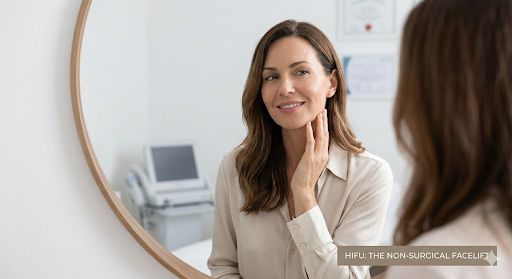
Skin laxity is an inevitable consequence of chronological aging and photoaging. As we age, the dermal extracellular matrix undergoes significant changes:
- Collagen production decreases by approximately 1% per year after age 20
- Elastin fibres fragment and lose their recoil capacity
- Hyaluronic acid levels decline, reducing skin hydration and volume
- The SMAS layer (superficial musculoaponeurotic system) weakens, leading to descent of facial fat pads
The result? A less defined jawline, sagging cheeks, and loose neck skin.
Traditional surgical facelift addresses these changes but requires incisions, general anaesthesia, and weeks of recovery.
High-Intensity Focused Ultrasound (HIFU) offers a non-invasive alternative. It delivers focused ultrasound energy to precise depths, triggering neocollagenesis and neoelastinogenesis without damaging the overlying skin.
At Hatsu in Penang, we use HIFU to achieve clinically meaningful skin lifting in appropriately selected patients.
What Is HIFU?
HIFU stands for High-Intensity Focused Ultrasound.
Think of it like a magnifying glass focusing sunlight into a hot spot. HIFU focuses sound waves deep under your skin to create tiny heat points.
These heat points trigger your body’s natural healing response. Your body responds by producing new collagen and new elastin – the two proteins that keep your skin firm and bouncy.
The result: Your skin becomes tighter, firmer, and lifted over time.
The Anatomy of Aging Skin
To understand why HIFU works, you need to understand what happens to your skin as you age.
The Three Layers of Skin
| Layer | Depth | What It Does | What Happens with Age |
|---|---|---|---|
| Epidermis | Very shallow (0.1mm) | Protects from the outside world | Becomes thinner, drier |
| Dermis | Middle (1-3mm) | Contains collagen and elastin | Collagen breaks down, skin loses firmness |
| SMAS layer | Deep (4-5mm) | A fibrous sheet that holds facial fat in place | Weakens, fat descends downward |
The SMAS Layer: The Key to Lifting
The SMAS (superficial musculoaponeurotic system) is the most important structure for facial lifting.
Think of it like a hammock that holds the fat pads of your cheeks and jawline. When you are young, the hammock is tight. Your cheeks are high. Your jawline is sharp.
As you age, the hammock stretches and weakens. The fat pads slide downward. Your cheeks droop. Your jawline softens.
During a surgical facelift, the surgeon cuts and tightens this hammock.
During HIFU, sound waves create heat points inside the hammock (at 4.5mm depth). This heat causes the hammock to contract and stimulates new collagen to strengthen it over time.
No cutting. No stitches. Just sound waves.
Important: Only the focal point reaches 60-70°C. The skin surface and surrounding tissue remain at normal temperature. This is why HIFU does not burn or damage the outer skin.
Who Is HIFU For?
Good Candidates (HIFU Will Work Well)
| Characteristic | Why |
|---|---|
| Age 35-60 | Collagen production is still active enough to respond |
| Mild to moderate sagging | You see drooping but not severe (Grade II-III laxity) |
| Realistic expectations | You want improvement, not perfection |
| Good general health | Normal wound healing capacity |
Less Ideal Candidates (Other Treatments May Be Better)
| Characteristic | Why | Better Option |
|---|---|---|
| Under age 30 | Minimal sagging to treat | Sunscreen, retinoids, prevention |
| Over age 65 with severe sagging | Skin may not produce enough new collagen | Surgical facelift |
| Very thin skin | Less collagen to stimulate | Fillers, thread lift |
| Active skin infection or disease | HIFU could worsen it | Treat underlying condition first |
Absolute Contraindications (Cannot Have HIFU)
| Condition | Reason |
|---|---|
| 怀孕: | No safety data |
| Pacemaker or implanted electronic device | Theoretical interference |
| Active cancer in treatment area | Could theoretically spread (unproven but precaution) |
| Open wounds or sores | Risk of infection |
HIFU: Quick Answers
Q1: How does HIFU work?
Sound waves heat deep skin layers to tighten and lift.
Q2: Why take 3 months to see results?
Your body needs time to build new collagen.
Q3: Is HIFU safe?
Yes, when done by a doctor. No burns or scars.
Q4: Does it hurt?
Mild warm tingling. Jawline may pinch slightly.
Q5: How many sessions?
Most need only 2-3 sessions.
Q6: How long do results last?
9-12 months.
Q7: Can I combine with Botox or fillers?
Yes. They work well together.
Q8: HIFU vs Ultherapy?
Same science. Ultherapy costs more。

 Chinese
  English